Bodies take longer
Software learned to see and speak in a decade. The machines that carry it into the world are still waiting on their joints.
Thesis
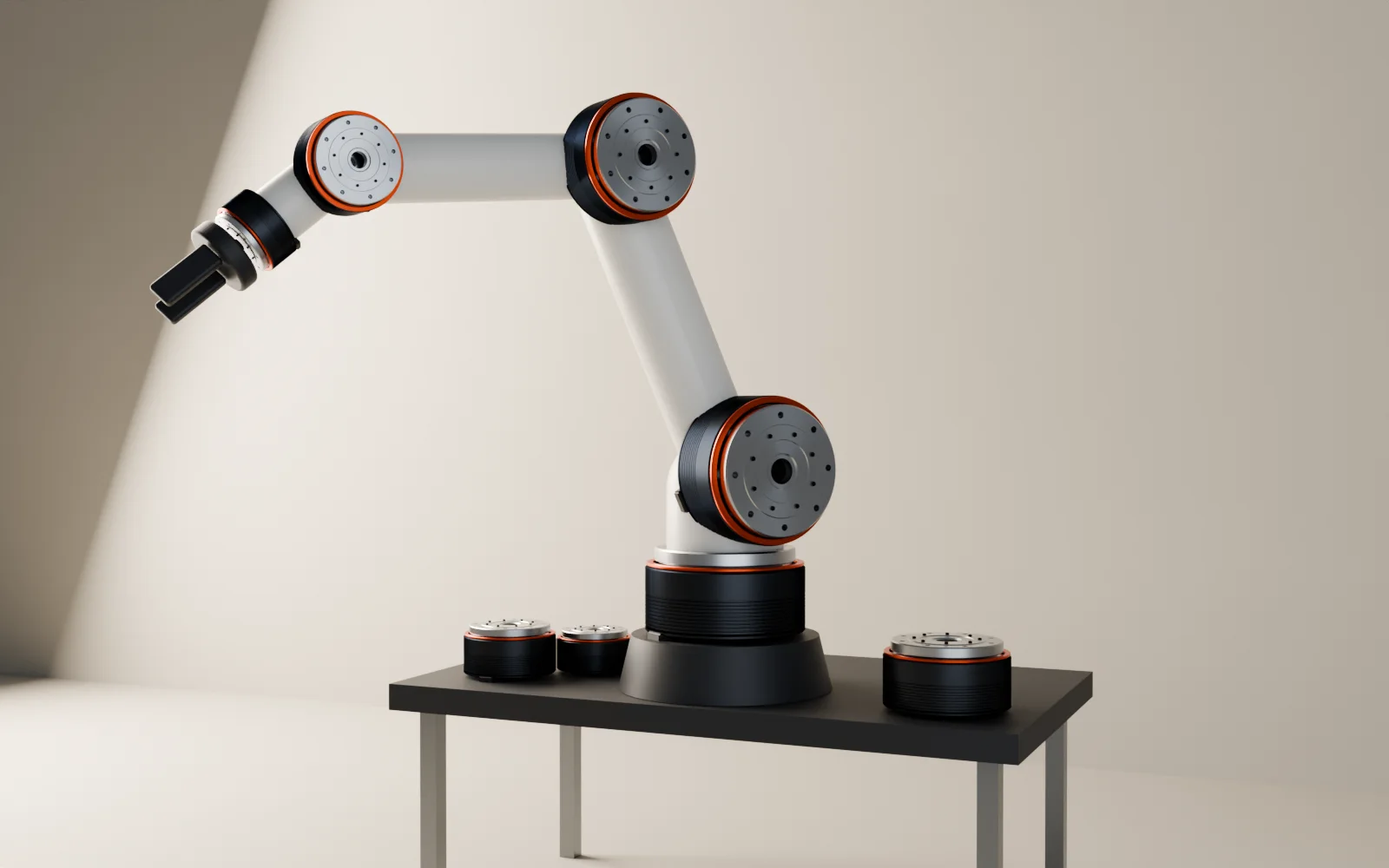
A humanoid has around thirty joints. An industrial arm has six. Every one of them is a small negotiation between torque, mass, heat, noise and price, and the robot is only as good as the worst joint in the chain.
For most of robotics history, those joints were bought from a catalogue built for factory automation: heavy, stiff, priced for low volume and shipped on long lead times. That was fine when a robot lived in a cage. It is not fine for a machine that walks through a warehouse or hands a part to a person.
The joint is the product
Get the joint right and the rest of the robot gets easier. A lighter wrist means a smaller elbow, a smaller shoulder, a smaller battery. A quieter gear means the robot can work on a hospital floor. A backdrivable joint means it yields when it touches someone instead of pushing through.
That is why we build strain-wave actuators and nothing else. We cut the gears, wind the motors, write the firmware and run every design to failure before we quote a volume.
Built where it is designed
Our engineers and our line share one building in Dayton, Ohio. When a joint fails on the dyno, the engineer who designed it walks thirty feet to see it. When a customer needs a different ratio, it is a change to a program on our machines, not a negotiation with a supplier on another continent.
We think the companies that win the next decade of robotics will own their supply of motion. Our job is to make that possible for teams who would rather spend their time on the robot.
What we will not do
- Sell a joint we have not run to failure.
- Hide test data from the people who depend on it.
- Ship a production part that differs from the one you qualified.